

A featured contribution from Leadership Perspectives: a curated forum reserved for leaders nominated by our subscribers and vetted by the Construction Tech Review Advisory Board.

ST Engineering.
The Next Chapter of Autonomous Shipping in Marine 4.0

NG Tee Guan
Even then, those who have been in the game already recognized the promise of enhanced productivity, and higher operational efficiency at lower costs that will drive the age of digitalization and revolutionize industries.
Indeed, researchers at the McKinsey Global Institute (MGI) have estimated that industries and companies that invest in digitalization could trim their operational costs on average by 3.6% and improve efficiency by 4.1%. The study also indicated that productivity increase of 3% to 5% are possible, while predictive maintenance and virtually guided self-servicing could also reduce maintenance costs by 10 to 40%.
When it first started, the UMVC’s key capabilities and focus was on the system integration of various platforms with a modular design that can accommodate payloads for different types of operations. Software was developed in-house to define mission-specific behavior that could meet operation and safety requirements. We launched the first USV capable of navigating in busy commercial waters in 2010, which also had the ability to operate fully autonomously with multi-modal collision detection and collision avoidance (CDCA) software, and was capable of performing autonomous maneuvers such as waypoint navigation, screening, and blocking. These efforts established ST Engineering capabilities in Navigation Autonomy.
Two years later, the Marine arm of ST Engineering embarked on the in-house design and development of a Ship Management System (SMS) for USVs. Addressing the Hull, Mechanical and Electrical (HM&E) autonomy of USV. The system, also known as NERVA SMS, is highly customizable to suit specific operations and demands of users and is based on an open architecture platform which adopts modular design. This flexible structure also incorporates a centralized control system that provides a clear view of the ship’s operations including propulsion, electrical functions, auxiliaries, and damage controls.
Constantly challenging ourselves to move in tandem with market needs and technology changes, in 2017, we unveiled the NERVA Ship Management System and Sensemaking System (SMS²) which added big data analytics to monitor equipment as well as perform predictive diagnostics.The IoT powered SMS² provides intelligent management and control through real-time centralized control and monitoring of platform sensors and systems with health monitoring and predictive diagnostics on platform machineries by incorporating data analytics and predictive analytics technique.
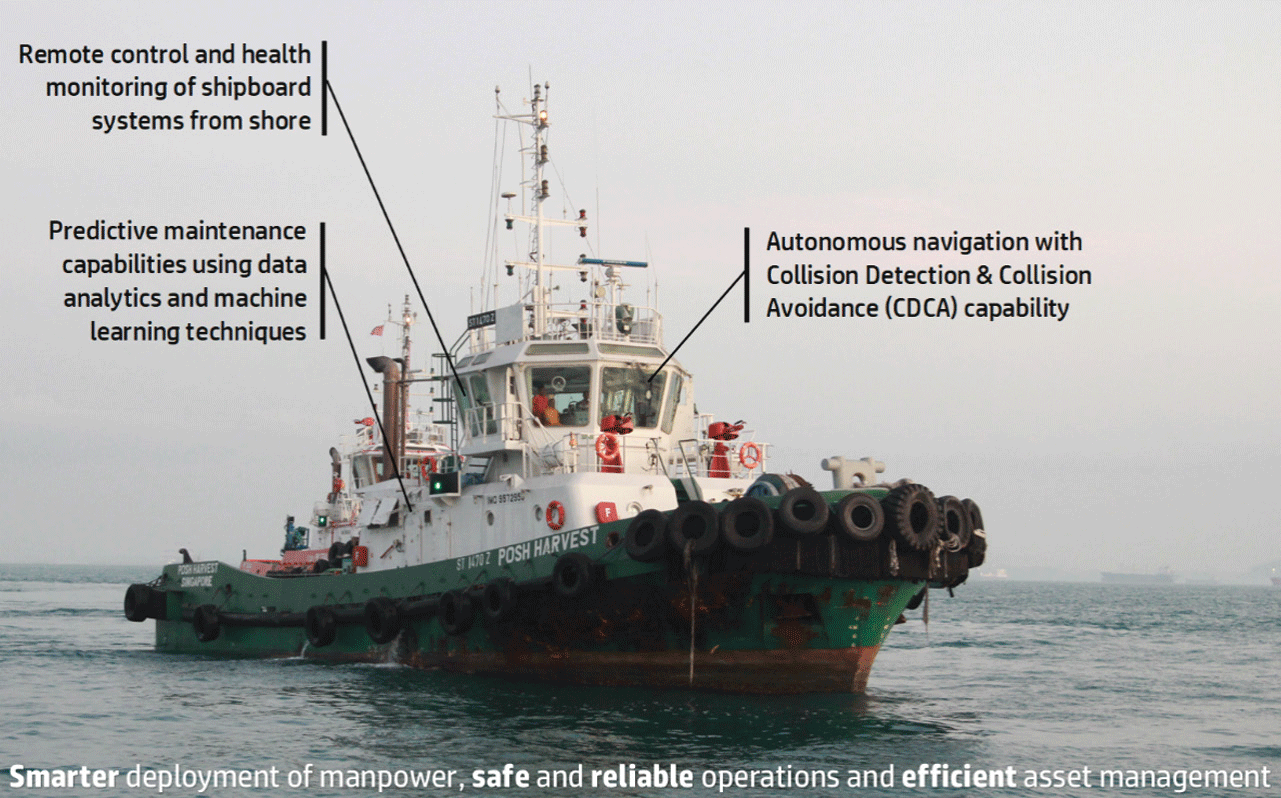
Caption: Smart Maritime Autonomous Vessel (SMAV) - Conversion of an existing manned PACC Offshore Services
Holdings Ltd (POSH) tugboat into an autonomous vessel with ST Engineering’s autonomous kit.
The main benefit of predictive maintenance to ship owners and operators is the reduction of unplanned downtime and an increase in the uptime of the systems. Unlike traditional preventive maintenance which is based on pre-defined scheduled intervals, predictive maintenance is performed only after abnormality or a decrease in the condition of the equipment has been observed. This translates to cost savings from unnecessary maintenance and improves productivity.
Maritime autonomous technology is taking shape at a rapid rate because it is not difficult to envision the safer, more reliable and efficient outcomes it can offer to mundane and repetitive operative tasks that could be labour-intensive or even dangerous. ST Engineering is actively working on projects to testbed this technology, starting from port operations to eventual ocean-going Maritime Autonomous Surface Ships (MASS).
An example of such an initiative in conjunction with MPA is the conversion of a manned tug boat to one with autonomous capabilities, by retrofitting the vessel with ST Engineering’s autonomous kit and NERVA SMS². The autonomous kit provides the Navigation Autonomy for the vessel to sail autonomously with Collision Detection and Avoidance. The NERVA SMS² provides HM&E Autonomy, giving visibility on the vessel’s status, prognosis and predictive maintenance which all result in enhanced operational, productivity and cost-efficiency for ship owners and operators.
Looking ahead, as maritime autonomous technology matures, vessel performances will also be enhanced and become more consistent, reliable and safer for all involved. No doubt, this is a game-changer of vessel design, construction, maintenance and repair processes, manpower distribution, and even port operations.
Before autonomous shipping becomes the new normal for us, there will be a complex matter of formulating international standards governing the operations of autonomous vessels. For one, the International Maritime Organization (IMO) will have to consider revisions to the International Convention for the Safety of Life at Sea (SOLAS) to allow ships with no captain or crew to travel between countries.
And here begins the new chapter of the Marine 4.0 journey.
See More: Top Marine Tech Solution Companies
